collaborating




"scars of the woods"
Point of departure: Whereas one of us was raised and socialised in a small village in the Palatinate Forest, one of the largest contiguous forest area in Germany, the other grew up in Ghent, a city in Flanders, a region with one of the lowest proportions of wooded landscape in Europe. Our conversations around forests, as human-inhabited and utilised landscapes and questions on how a forest can resist and remain have somehow sedimented in the foundation of our relationship already for a long time.
Spending time with a forest brought us towards a deeper sensibility for its constant pain. As a result of the contemporary effects of a century-long crafting of the forest as a landscape to be exploited, it is today a weakened patient, suffering from heat, drought, storms, and extensive bark beetle infestation. The forest has become what its inhabitants wanted it to be through decades of monocultural forestation, economically motivated private ownership, and radical environmental interventions such as soil liming. For the forest and ourselves, we therefore wonder: How can we stimulate imaginations of future scenarios for this forest that are no longer bound to private ownership and the residues of economic extraction, but instead imagine the act of 'giving back' to a suffering patient together?
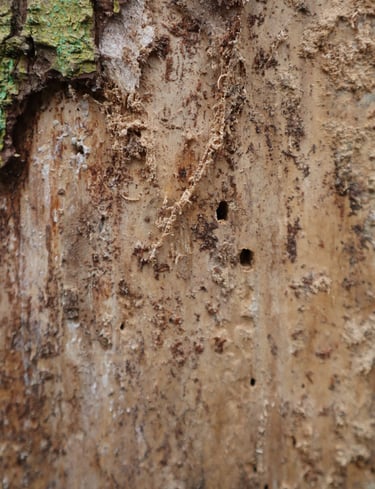
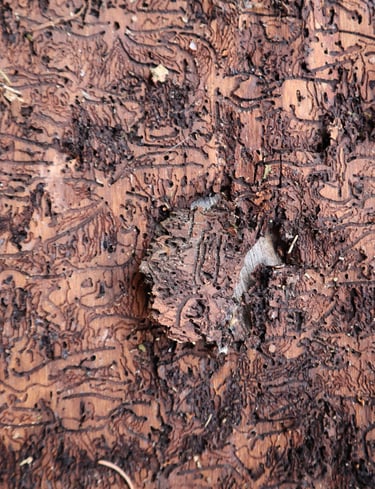
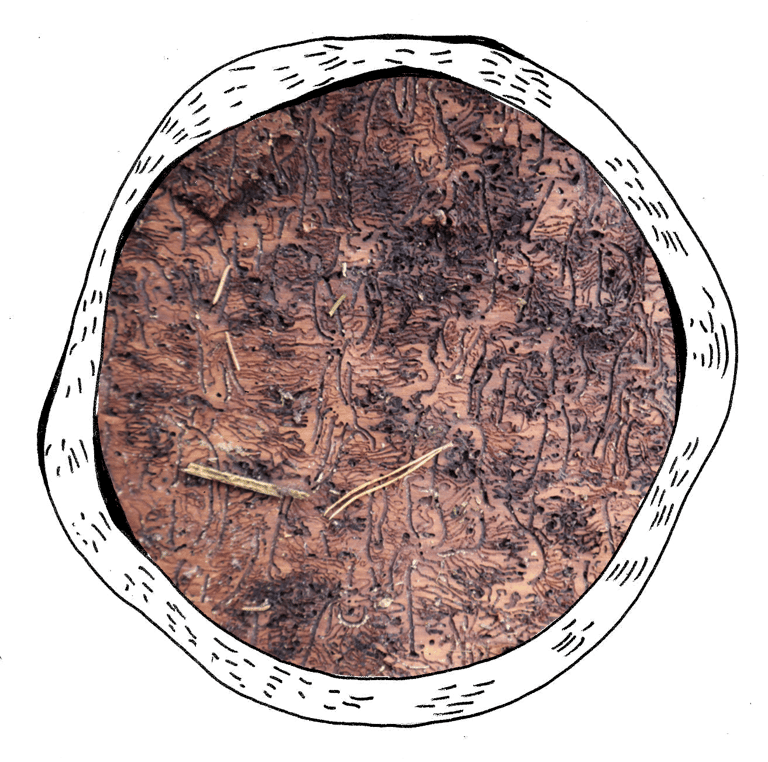
The visible deadly wounds on the inner bark of the locally, monoculturally planted pine trees prove that the European spruce bark beetle (Ips typographus) has used trees weakened by recent climatic conditions as breeding centres.
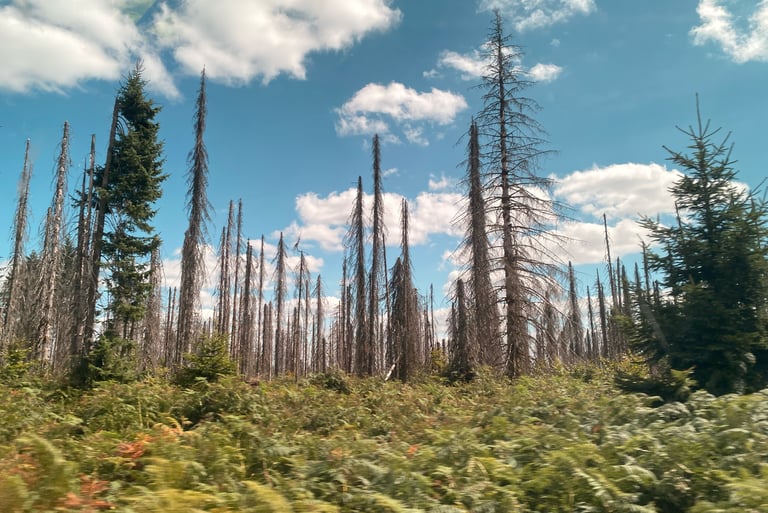
Often, these bark beetle populations can wipe out entire monocultural sites of pine trees, leaving behind a field of dead wood: thin pine sticks bobbing in weak breezes of hot summer standstill. This is the moment in which the trees are reduced to their economic capacity as firewood, extracted from the rest of their life cycle. But for us, this moment of perceptual standstill allows us to pause and navigate through worlding and storytelling somewhere other than in a sawmill or on a forest owner’s bank account.
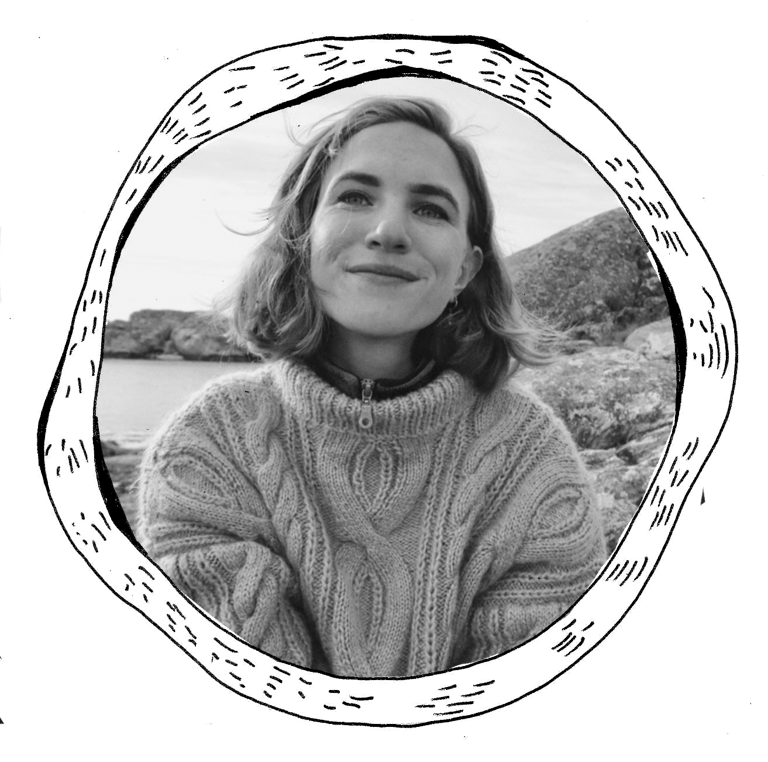
Supported by the mobility grant Culture Moves Europe, Ida and Jaron were given the possibility to conducted initial research for the project Scars of the Woods (2024–ongoing). They spent a week in a small village in the Palatinate Forest in Germany, trying to understand better how century-long co-habitation between humans and the forest is materialised within the forest today and speculating what it could become in possible futures. This was documented through written reflections, drawings, and speculative material research propositions.
Excerpt, Research Diary


From here, we want to cultivate a “common imaginary landscape,” which we understand, with Max Haiven and Alex Khasnabish, not as a steady state but as an active process (2014). To initiate this process, we communicate a speculative proposal of what we want these black holes to become: a breeding ground for mycelium, fostering mushroom growth and kickstarting the fertile composting process of the dead wood, slowly giving it back to its surroundings and continuing its life cycle. Haiven and Khasnabish highlight that an imaginary landscape is not identically inhabited by its members, but rather that “it ‘sparks’ from the friction between individuals, groups, ideas, strategies, and tactics” (2014). We continue to propose our imagination to different groups of people, locally and trans-locally, to foster alternative imaginaries and explore these frictions.


